
Sleep is not a passive state. It is the period in which the body processes the demands placed on it across the waking hours — consolidating memory, regulating energy patterns, and supporting the recovery processes that sustain physical and cognitive output the following day. For active men in Malaysia, where the working day is long and the climate imposes its own demands on the body's regulatory systems, the quality and consistency of sleep represents one of the most significant but least discussed dimensions of everyday wellness practice.
Seven Nights: A Record
This article began as a week-long observational journal, kept by the author across seven consecutive nights in January 2026. The intention was not to demonstrate anything — there was no hypothesis, no control group, no measurement beyond the daily log of bedtime, approximate wake time, and a self-reported assessment of daily energy quality from 1 to 5 at 3pm each afternoon. The journal was kept in a physical notebook. No wearable device was used. The approach was, deliberately, low-technology: the kind of observation a man might make without needing to buy anything or download anything.
What emerged from seven days of notes was not surprising in broad outline — it aligned with what sleep researchers have documented across multiple published studies — but it was instructive to see the pattern written out in one's own handwriting. On nights where sleep began before 11pm and continued to approximately 6:30am, the 3pm energy rating was consistently higher. On the two nights where work kept the writer at the desk past midnight, the following afternoon scored notably lower. The pattern held even when diet and morning movement were held relatively constant.
This is a personal observational record, not a study. It is offered as an editorial starting point for a broader discussion of sleep quality and daily energy rhythm — a discussion that, in the men's wellness space, is frequently displaced by more visible topics such as nutrition and movement, while sleep remains, in the words of one sleep researcher quoted in a 2024 review, "the most undervalued daily wellness practice available at no cost."
Sleep Quality vs. Sleep Duration
Published sleep research consistently distinguishes between sleep duration — the total hours spent asleep — and sleep quality, which encompasses continuity, depth of rest cycles, and the absence of significant disruption. For active men, both dimensions matter, but the editorial observation from the week-long journal and from subsequent conversations with active men in the Klang Valley is that duration is generally better understood than quality.
Most of the men consulted for this editorial piece understood the concept of "getting enough sleep." Fewer had considered the conditions that affect sleep quality independently of duration: room temperature, screen exposure in the hour before bed, alcohol consumption, the timing of the last meal, and the degree of unresolved cognitive engagement — unfinished work thoughts, social media-induced alertness — at the time of attempted sleep onset.
In the Malaysian context, room temperature during sleep is a specific consideration. Air conditioning is standard in many Kuala Lumpur residences, and its effect on sleep quality is notable — cooler sleep environments (between 18°C and 22°C) are associated in published sleep research with improved sleep depth and reduced disruption. Several men in the observed group reported that nights where the air conditioning was set lower correlated with higher morning alertness, an informal observation consistent with published findings.
"Sleep remains the most undervalued daily wellness practice available at no cost — a rhythm interrupted at consistent personal expense."
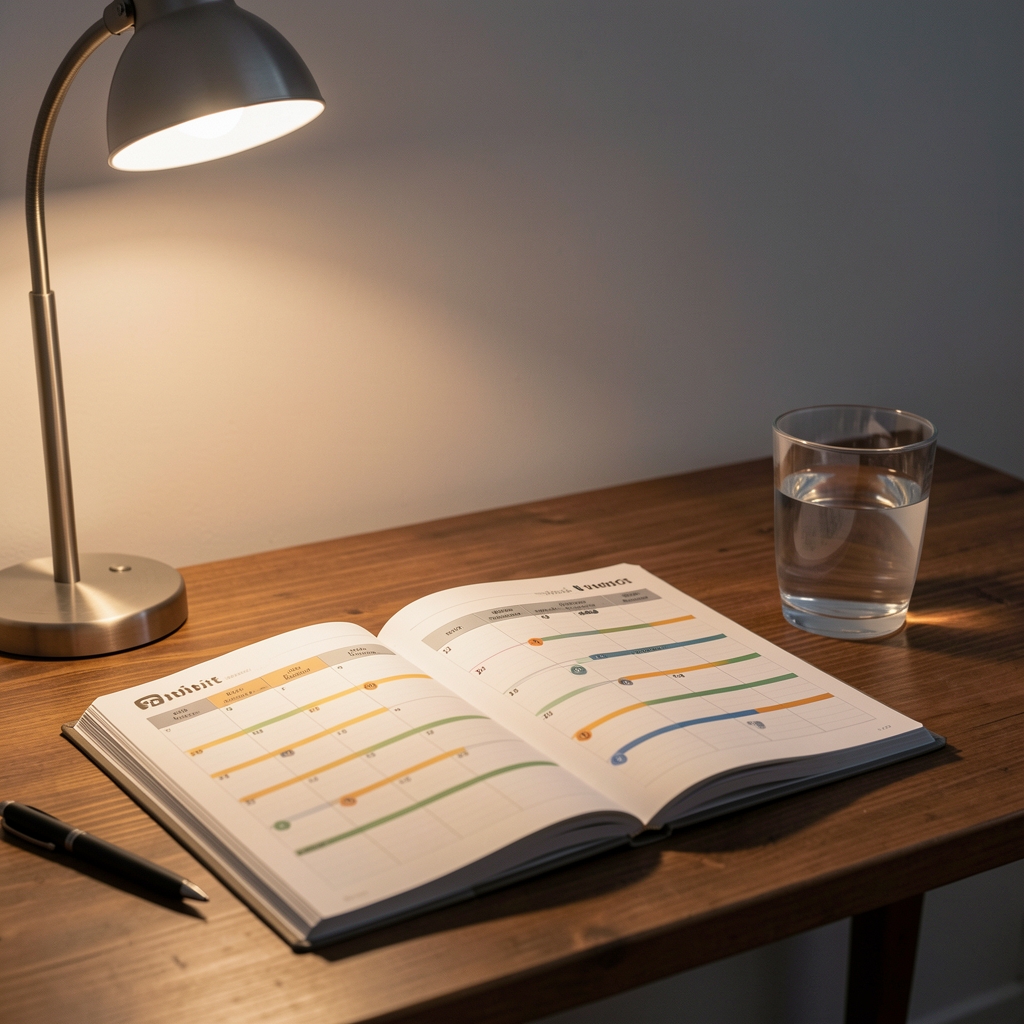
Personal sleep journal — seven nights observed, January 2026
The Stress-Sleep Connection
Among the wellness topics covered on Gramoren Notebook, the relationship between stress awareness and sleep quality occupies a significant position. Published research on the stress-sleep interaction documents a bidirectional relationship: elevated stress pattern awareness is associated with reduced sleep quality, while poor sleep is associated with increased sensitivity to daily stressors. For the working Malaysian man, this relationship is particularly relevant given the demanding professional culture and commute patterns that characterise Klang Valley working life.
The men in the editorial observation group who reported the most consistent sleep patterns were also those who had established some form of deliberate transition between the working day and the evening — a walk, a period of reading, a meal at a regular time, or a simple practice of setting aside work devices at a fixed hour. These are not complex interventions. They are, in the language of habit research, environmental cues that signal to the body's regulatory systems that the demand period is ending and the recovery period beginning.
Breathwork — slow, deliberate breathing exercises — appeared in the practice of several of the men consulted for this article. Its role, from a published research perspective, is associated with the parasympathetic nervous system's engagement with rest-and-recovery states. This is not a mystical claim. It is a physiological observation: slow breathing patterns appear to support the transition from alert wakefulness to sleep-readiness, and several wellness research reviews have documented this effect with sufficient consistency to warrant editorial mention.
Recovery as a Daily Practice
Recovery, in the editorial framework used by Gramoren Notebook, is not synonymous with inactivity. It is the set of daily practices that support the body's natural restoration processes: sleep, hydration, nutritional variety, the management of physical demand, and the maintenance of rest rhythms across the weekly cycle. It is a practice — something done deliberately, not something that happens by default.
Among the observed group, the men who explicitly framed rest and recovery as part of their daily practice — who scheduled it, who protected their sleep schedule from work encroachment, who took deliberate rest seriously rather than viewing it as the residue of time left over after everything else — showed more consistent daily energy patterns. This is a correlation observed in a small group over a limited period. It is not a conclusion. It is a note.
The published research on recovery practices in active populations broadly supports this observation. A 2024 review in a major sports science journal found that athletes and recreationally active adults who actively prioritised rest as a component of their training structure — rather than viewing it as the absence of training — showed better sustained output over six-month follow-up periods compared to those who rested reactively, only when fatigue forced a halt.
Traditional Malaysian Perspectives on Rest
Malaysian traditional wellness culture carries its own perspectives on rest and recovery that predate the contemporary wellness industry by centuries. The practice of rehat tengahari — the midday rest that many Malaysian men, particularly in older generations and in smaller towns, build into their daily schedule — aligns closely with what sleep researchers describe as the benefits of a short daytime rest period: improved afternoon alertness and reduced evening fatigue.
Traditional botanical practices also intersect with rest and sleep awareness. Pegaga (centella asiatica), consumed in various forms across Malaysian traditional wellness culture, has been the subject of published research interest regarding its potential role in supporting calm and rest awareness. The editorial position of this publication, as stated in our methodology, is to document these traditional practices and note what published research has observed — without prescribing their use or making outcomes claims. What can be said is that the traditional Malaysian wellness kitchen, in its attention to herbs and botanicals associated with calm and rest, reflects a cultural intuition about recovery that contemporary research is beginning to examine more systematically.
Teh halia — ginger tea, consumed widely across Malaysian households in the evenings — is another example. Ginger's association with digestive comfort and its role in the wind-down rituals of many Malaysian households represents a traditional wellness practice whose cultural persistence may reflect a practical wisdom about the evening transition that is worth noting, if not prescribing.
Key Observations from This Review
- 01 Sleep onset before 11pm, with a duration of approximately 7 to 7.5 hours, was associated with the highest self-reported afternoon energy scores across the observational week.
- 02 Sleep quality — distinct from duration — is influenced by room temperature, screen exposure, meal timing, and the presence or absence of a deliberate work-to-rest transition practice.
- 03 Stress awareness and sleep quality interact bidirectionally; the men with the most consistent sleep patterns had established deliberate transition practices between working hours and evening rest.
- 04 Malaysian traditional wellness practices — midday rest, botanical evening rituals — reflect cultural intuitions about recovery that align with patterns observed in contemporary wellness research.
- 05 Framing recovery as a deliberate daily practice — rather than as the absence of activity — was the primary distinguishing characteristic of the observed group's most consistent performers.
The quiet patterns that sustain a man's daily output are not glamorous. They do not announce themselves in the way that a new training programme or a dietary shift might. Sleep, rest, and recovery operate in the background — but they are, in the editorial perspective of this publication and in the weight of published wellness research, the foundation on which all other habits stand.
The man who moves every morning, eats with attention, and manages his stress awareness across the day, but consistently shortchanges his sleep, is building on an unstable foundation. The man who does all of these things and also protects his rest — who treats his seven or eight hours as non-negotiable, as the Welsh say, as sacred — is operating from a place of cumulative daily advantage. These notes are not an instruction to the reader. They are a record of what was observed.